



On the radio program New America Now, Andrew Lam recently interviewed Isabelle Thuy Pelaud about This is All I Choose to Tell: History and Hybridity in Vietnamese American Literature, the first book-length study of Vietnamese American literature. Here diaCRITICS managing editor Julie Thi Underhill describes and reviews their fourteen-minute radio conversation. “But it is even better to hear them talk together,” Julie prefaces, “so consider this foreshadowing.”
[Before we begin: have you heard about our subscriber drive? win an iPod and other prizes!]

In this radio interview with Andrew Lam, featured on New America Now, Isabelle Thuy Pelaud discusses her first book, This is All I Choose to Tell: History and Hybridity in Vietnamese American Literature, while explaining how Vietnamese American writers have challenged the demand to tell a “war story” through their literature. Isabelle shows how this reluctance on the part of Vietnamese American writers articulates their need for both privacy and resistance — succinctly captured by poet and artist Trường Trần’s declaration, this is all i choose to tell, the phrase that inspired the first half of Isabelle’s book title.
To explain the origins of this phenomenon of choosing to tell only so much, Isabelle overviews the evolution of Vietnamese American literature in the past 30 years, in this interview and in her book. Nostalgia for the past underscores the first generation’s writing, usually framed within military historical accounts that reveal the writers’ ultimate ambivalence about “rescue” by the United States — war determines so much of the narrative and meaning of these texts. However, the next generations of Vietnamese American authors, schooled through Asian American literature and ethnic studies courses, write with less concern about war and with more attention to identity. These second and third generation authors are notably concerned about what it means to be Vietnamese American. Isabelle’s analysis of Vietnamese American writers reflects a nuanced awareness of intergenerational differences, as each generations are proximate to (or distant) from war.
In the beginning of the interview, Andrew first asks Isabelle about her own identity — her background as a Vietnamese-Eurasian born in France, and her immigration to the U.S. at age nineteen — before delving into her Vietnamese American literary criticism. Although it might seem like a natural opening, Andrew’s choice to begin this way foregrounds Isabelle’s later observations about contemporary Vietnamese American writers’ attentions to identity. As the interview continues, Andrew asks Isabelle about the notion of hybridity, as it applies to Vietnamese American identity. Isabelle explains how her critical attention to hybridity counters the standard notions of assimilation (to Anglo-Saxon culture) to which the North American “immigrant narrative” is so often bound. Going back even further, Vietnamese culture itself has been heavily influenced by outside forces — Chinese, French, Russian — which complicates notions of “purity” by affirming the long presence of hybridity within Vietnamese history and culture. As I listened, I considered how hybridity also occurred from the other direction, as a result of the conquest and assimilation of the Cham and other indigenous communities. Indeed Isabelle’s observations resonate with others’ understandings of Vietnameseness. Inter-ethnic and transnational, the dynamic of cultural “mixing” has been around for thousands of years in Vietnamese society.

Together Andrew and Isabelle look ahead to the next ten years of Vietnamese American writing. In doing so, they must revisit what’s truly different for the second and third generations. Isabelle foresees the continued challenge to resist the “war story” narrative. “Viet Nam is such a strong presence in the U.S.,” Isabelle cautions. This hypervisibility of “Viet Nam” as a war (not a country) puts much pressure on Vietnamese American writers to perform and reenact war stories, even when they have no direct experience or memory of war. Understandably, Vietnamese American writers are frustrated by this bounded framework of performativity and reenactment. On the other hand, Vietnamese American authors have already chosen to tell complicated stories decentering war, while expanding notions of who and what’s appropriate to feature in their writings. Isabelle points out, “Lots of texts don’t fit expectations of Vietnamese American writing,” including the works of Monique Troung, Linh Đinh, and Trường Trần. She also anticipates that certain topics, such as sexuality, will become increasingly less taboo to portray, an evolution which will counter the “holding back” of past generations of Vietnamese American writers, and even the withholding of the newer generations, who have “layers of vulnerabilities, from being refugees and the children of refugees.”
The interview ran on June 10, 2011, on New America Now, the radio program of New America Media, founded by Vietnamese American journalist and author Andrew Lam. He’s guest blogged for diaCRITICS before, and we’ve printed his other conversations, including his April 2011 interview with Angie Chau.
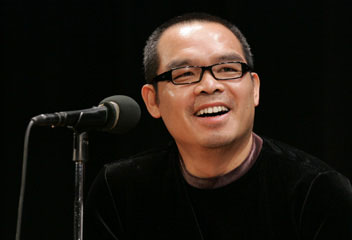
— Julie Thi Underhill is managing editor of diaCRITICS. She’s previously written for diaCRITICS about her ‘authenticity’ as a Vietnamese-American, Democratic Kampuchea’s Genocide of the Cham, Isabelle Thuy Pelaud’s launch party for this is all i choose to tell, UCLA’s VSA culture show tribute to Tam Tran, the first San Francisco Diasporic Vietnamese Film Festival, and an exclusive “intervu” with writer Vu Tran.
Please take the time to rate this post (above) and share it (below). Ratings for top posts are listed on the sidebar. Sharing (on email, Facebook, etc.) helps spread the word about diaCRITICS. And join the conversation and leave a comment! Who is your favorite author of Vietnamese descent? Do you perceive these “generational” shifts in the writings of Vietnamese Americans? What do you think about this idea of “holding back”?

Perhaps, This Is All I Choose To Tell is just that. In the interview Isabelle tells us that her book focuses on the new younger generation who is less concerned about nostalgia, Vietnam, and the war (aftermath) but more about their identity (and ambivalence) in America.
While the direction the writers take maybe helpful to enlighten the mainstream about the psyches and viewpoints of those Vietnamese-Americans who have been fortunate enough to established themselves successfully as published authors, it becomes problematic in the sense that it does NOT take into account the ‘hybridity’ that the author endeavors to clarify. In fact, the wish of these writers not to be assimilated as Anglo-Saxon in the U.S. has at least linguistically transformed them partially in the English-American culture. As English writers, they may not be touting Anglo-Saxonism, but have they accidentally or willingly detached or distanced themselves from their Vietnamese identity and roots? Does this process of becoming an immigrant-mainstream English writer contribute holistically to the concept of ‘hybridity’? To be fair, Isabelle Pelaud’s book is not about those people who may feel grateful as (time-expired) refugees, or framed by the war experience, abandoned by America, or whatever the 37 years of living in America has wrought them.
Yet somehow, I feel as if at least three quarter of the body of Vietnamese work has been neglected and thus the psyche and ethos of the Vietnamese (can we call them Vietnamese-Anericans?) may never be fully understood.
Far out. Will listen to the interview. Have the book in my bag and looking forward to writing about it. It seems to me that assimilation in the US is not to “Anglo-Saxon” culture but to whiteness. The actual “Anglo-Saxon” ethnic groups include distinct traditions, importantly the poor whites on the one hand and the WASP clans on the other. Both have strong ties and shared traditions with the enslaved families, all three comparatively less close to the 19th C immigrants and especially the to the post-75ers. But everyone in the US is in dialogue with whiteness, the condition of unmarked domination. This view is from an anthropologist, not from ethnic studies. I am expecting that my view of Vietnamese literature in the US will differ from Isabelle’s similarly, in my focus on work in Vietnamese and work that has not been encouraged by white editors in corporate houses and by universities, all in the stream of ethnicity that Andrew advocates for so well. A difference in point of view, which is what we’re after, right, which will not differ so much when we do talk about the same things.