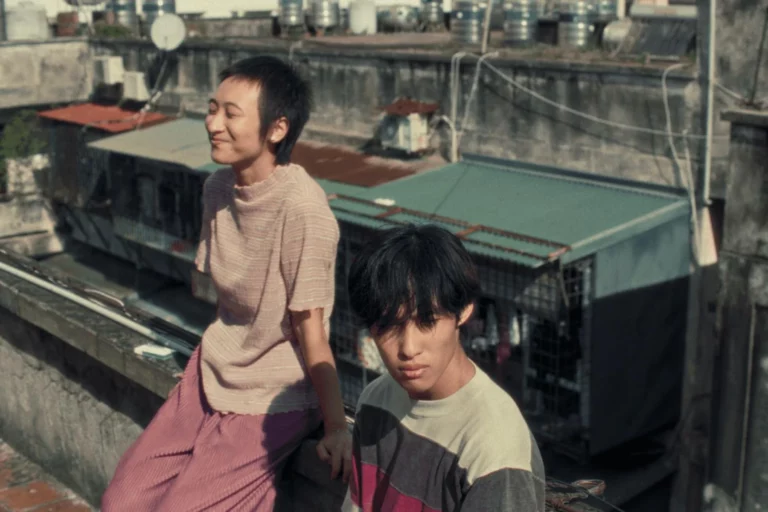
In his sophomore feature film Quán Kỳ Nam (Ky Nam Inn), Vietnamese American director Leon Lê brings another tale of Saigon in the 1980s to the big screen. While his debut film, Song Lang, showcased the second golden age of cải lương (Vietnamese opera) through a queer love story between a singer and a debt collector, this second film examines the lives of neighbors in an apartment complex where the aftermath of war has shuffled old occupants with new tenants, Southerners with Northerners. Ky Nam Inn focuses on a widow named Kỳ Nam (Đỗ Thị Hải Yến), once married to a Southern general who was forced into a reeducation camp after the war, and her emotional entanglement with Khang (Liên Bỉnh Phát), a young translator who moves from Da Lat to Saigon for work thanks to the connections of his uncle, a Communist Party bigshot. Through the different backgrounds of these two characters and their lively neighbors, Lê tells a riveting tale for the Vietnamese–those who left after the fall of Saigon in 1975, those who stayed, and how they learned to live together, in hurt, hope, and healing.
Lê’s sublimated memories of leaving Vietnam for America at age 13, Bob Nguyen’s artful cinematography, and the grainy look of 35mm film, all serve to transport the viewer to Saigon in 1985, where the film is set. In Ky Nam Inn, beauty and poignancy can be found when the camera lingers. For example, one of the scenes from Khang’s move-in day includes a scraggly, tireless man who earns his living by collecting and reselling scrap metal and electronics. The man’s daily rounds throughout the apartment complex adds to the urban Vietnamese morning soundscape of loud traffic, music, and announcements. As the film progresses, Lê presents a detailed aesthetic in the daily milling about of the tenants, the businesses within, and its regulars. When the scrap merchant reappears, a neighbor asks why they hadn’t seen him in the last few days. When he shares that his youngest child is sick, his neighbor sets aside electronics for him to collect. Proximity gradually builds trust and familiarity, with the tenants organizing tontine, and the young and old crowding around a small television (possibly the only unit in the entire building) to watch cải luong after a long day of work.
Within the hustle and bustle of the apartment complex, an unlikely trio bonds in the repetitive tasks of preparing meals. Kỳ Nam lives by herself in Apartment 1A and runs a meal service for locals, with hired assistance from Su (Trần Thế Mạnh), an Amerasian teenage boy. The film takes its title from the sign that her son painted in front of the unit: Quán Kỳ Nam. While “quán” suggests an eatery or café rather than an inn, Ky Nam’s apartment is neither a restaurant nor an inn. Nevertheless, when Kỳ Nam sprains her wrist and Khang offers to help her in the kitchen (because a procrastinating writer will happily do anything other than write), Kỳ Nam Inn becomes a gathering place for the three characters.
Each represents a different generation impacted by the war. Kỳ Nam is a relic of the South. Always well dressed, hair done up, she was once a highly regarded Madame who is now restrained and given to deep sadness. Khang enters her life at a time when the tragedies of war have finally given her some respite, even if the ghosts of her past still seep into everyday life. Details about Ky Nam’s life are steadily revealed through what people claim to have heard about her, rather than what she shares herself. Meanwhile, Su is a lost boy, the child of an American soldier and Vietnamese woman, now a burden to his uncle’s family and bullied for his mixed race, a shared fate of Amerasian children after the war. Only through meeting Khang, an educated and open-hearted man, does Su sees his name and his own potential differently. His name means “darling” in French, for there was a time when he did have a parent who cherished him.
Compared to his new companions, Khang’s background is enviably full of postwar potential as a result of his uncle’s wartime contributions to the North Vietnamese side. Uncle Tan never appears in the movie, but his great influence and disapproval of Khang’s generosity to Kỳ Nam Inn are felt. But spending time with Kỳ Nam and Su helps Khang experience the deeper message in his assigned translation job, Antoine de Saint-Exupéry’s 1943 tale Le Petit Prince. Khang translates a section of the famous story to Su: “The prince asked to befriend the fox. The fox said in order to do that, they must meet patiently every day. At first, they must sit far apart and can only look at one another. Each day, they can move a bit closer. The key is to set a specific time, so both can mentally prepare… If we set a date for 4 p.m., by 3 p.m. I’m already starting to feel happy.” Despite how war has fractured Vietnamese identity, Kỳ Nam and Khang arrive at not only an emotional understanding, but an entanglement. Kỳ Nam’s wrist injury heals, while time with Khang is a salve for her tired heart.
Ky Nam Inn tells the stories of those who had to rebuild their lives in Vietnam after the war, while also remembering the Vietnamese who left (“vượt biên”). While Khang stays in an apartment that the government granted to his uncle for his cultural merits, he is curious about the people who previously called the place home. He notices the markings that remain on the wall, such as the heights of some children tracked over the years, ending abruptly in 1975. When Kỳ Nam’s son offers to paint over it, Khang says to leave their home as it is. Khang’s response feels like a quiet acknowledgement that there will always be a piece of those who fled that remains in the motherland, even if governments change. This piece of their home is preserved, even if no one can return to claim it. Ky Nam Inn also delicately handles the reality of vượt biên. It is Kỳ Nam’s most recent grief, having received no mail from her son Dương who “suddenly ran away” a year ago. Eventually Kỳ Nam, her remaining son Don, Khang, and Su hold their own memorial service, lighting incense for Dương by the water. A memorial for those who died trying to escape Vietnam by boat during its economic and political turbulence is embedded in this film that is well on its way to be a classic. This quiet, meaningful scene is something that I will hold onto and continue to think about.
Ky Nam Inn also has its humorous moments. One absurdist scene, which speaks to the Vietnamese spirit of resilience, occurs when the police shuts down a celebration as an unauthorized “large gathering” and places the group of well-dressed partygoers in a holding cell overnight. Rather than dwell in bitterness, a guest jokes that the host can just treat them to phở in the morning, bringing a rumble of laughter in the most unexpected place. This tender moment, a mix of humor and optimism during unideal circumstances, is something I recognize in the Vietnamese American relatives and neighbors I grew up with. My parents had spent their twenties in the inhumane and crowded conditions of the refugee camp. But in transferring from place to place in Hong Kong, my parents also met and married each other in a refugee camp, among close friends. There is an optimistic touch to Lê’s storytelling that echoes my family’s own: while life is tough, one can still choose to bring out the beauty and humor of it.
There is something for everyone in this film. Lê’s allusions to popular French and Soviet stories invite a well-read audience to consider how Vietnamese people resonated with not only Le Petit Prince, but also the coming-of-age novel Sans Famille by Hector Malot, the romantic comedy and melodrama Moscow Does Not Believe in Tears, or Albert Camus’ The Adulterous Woman. But Ky Nam Inn is especially for the Vietnamese, who recognize their lives through the film’s intricate set and character designs. The film is for those who stayed after the war, those who left, and folks like me, a child of the diaspora who first knew Vietnam through family stories before having stepped foot inside the country. The film is for those who feel that they have lost their country and never want to return to Vietnam under its current government. Lê’s film remembers them anyway. Making its Orange County debut, Ky Nam Inn is a fittingly contemplative film to end the 2026 Viet Film Fest.

Cathy Duong co-hosts cà phê book club, a monthly book club that meets in coffee shops across north Orange County, CA (IG: @caphebookclub). She enjoys traveling to Little Saigons, playing V-pop on her ukulele, and analyzing diasporic Viet literature.